The story of the temple
History of Ikkeji Temple
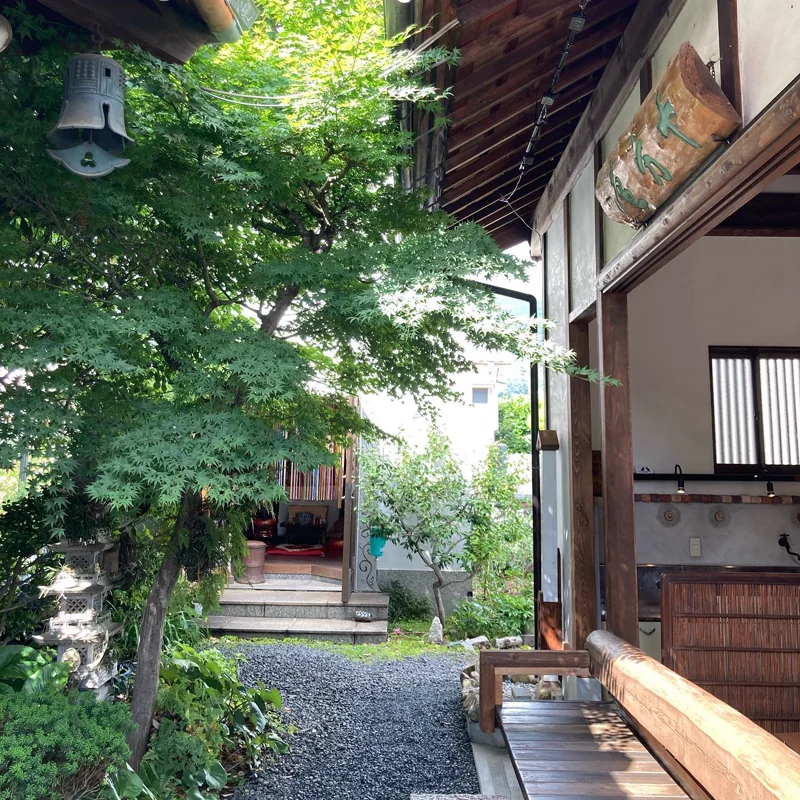
Ikkeji is a Rinzai Zen temple whose full name is Goyozan Ikkeji. Its principal image is Nyoirin Kannon, a form of Kannon Bodhisattva. The temple's story is deeply connected with the rise of modern Kure.
Temple Profile
- Name
- Goyozan Ikkeji Temple
- School
- Rinzai Zen Buddhism
- Principal image
- Nyoirin Kannon Bodhisattva
- Guiding values
- Practice, gratitude, and Kannon
Nyoirin Kannon is revered as a compassionate bodhisattva who offers wisdom and blessings, helps break through worldly attachments, and guides people toward relief from suffering.
The temple has a guiding phrase: "Turn around, and Kannon is there." It expresses a simple view of Buddhism: awakening is not far away. It is found in how we notice life, recover confidence, and return to the present moment.
Kure Becomes a Naval City
The Kure Naval District was established in 1889. Around that time, Kure was changing rapidly from a farming and fishing community into a naval city.
The transformation began even earlier, in 1886, when preparation for the naval base brought land purchases, relocation of local families, military construction, and the later establishment of the naval arsenal. Workers, sailors, and young men from other regions poured into the area.
Kure became a newly opened town where hopes, hardship, ambition, poverty, and opportunity were mixed together. Temporary houses stood side by side, and people from many backgrounds learned to live in the same place.
This rough and open atmosphere helped shape Kure's character. It was a city of labor and military discipline, but also a city where different people could meet. In that setting, Zen practice found an unexpected place.
Beginnings as a Branch Temple of Buttsu-ji
Many young naval officers in Kure practiced Zen at Buttsu-ji Temple in Mihara. In October 1894, Zen master Kanryo Osho, the head priest of Buttsu-ji, was invited to speak at the naval district headquarters.
There he met Toyoda Mitoshi, a physician and public figure known for his integrity. Toyoda had once been elected to the House of Representatives from the Kaishinto party. Later, disillusioned by political interference, he returned to medicine and devoted himself to public welfare in Kure.
In 1895, Toyoda built a small hermitage next to his clinic. It became a lodging place for Kanryo Osho and a meeting place for monthly Zen practice. A modest sign read "Buttsu-ji Office."
In 1905, the small hermitage formally became a branch temple of Buttsu-ji. Kanryo Osho entrusted it to his beloved disciple Toyoda Chikai Osho, giving him a statue of Nyoirin Kannon that he had personally carried with him.
Chikai Osho, then twenty years old, was taken in as Kanryo Osho's adopted son and given the Dharma name Kanko (寛厚). The everyday life of Kanko Osho (寛厚) in Kure was built around takuhatsu, the traditional practice of walking through the town to receive offerings.
Zen Practice and the People of Kure
The branch temple became a place where naval officers, judges, teachers, lawyers, and other educated people of the time gathered. Naval officers often came on Saturday evenings, sharing hot tofu and sake in a relaxed atmosphere.
At the same time, Kanko Osho (寛厚) continued his daily rounds of takuhatsu. His figure moved through the streets of Kure as the town grew and struggled around him.
Several young people were moved by his life and became disciples or long-term supporters. The temple was not only a place for formal religion. It was woven into the daily life of a city that was still finding its shape.
The Name Ikkeji
In 1921, Toyoda Mitoshi donated about 300 tsubo of pine forest at the foot of Kitasako Hill. A main hall and priest's quarters were built there, and the temple formally took the name Goyozan Ikkeji, with Kanryo Zenji honored as its founder.
The name "Ikkeji" is connected to Ikka-an, a sub-temple of Buttsu-ji where Kanryo Osho had once served as resident priest.
It also echoes a verse attributed to Bodhidharma: "I came to this land to transmit the Dharma and free people from delusion. One flower opens into five petals, and the fruit ripens naturally." The image suggests how a single practice can spread, take root, and bear fruit over time.
War, Loss, and Rebuilding
Ikkeji was destroyed in the air raid on Kure on July 2, 1945. Until the end of the war, Kure had been crowded with naval sailors and arsenal workers. Its population had reached about 370,000, and rose even higher when the Combined Fleet entered port.
Many naval officers had practiced Zen at Ikkeji, and the temple once had nearly twice as many supporting families as it has today. After the bombing and Japan's defeat, Kure's population fell to about 100,000. The temple's supporting families also decreased sharply.
For more than a decade after the war, the temple continued its activities in temporary buildings.
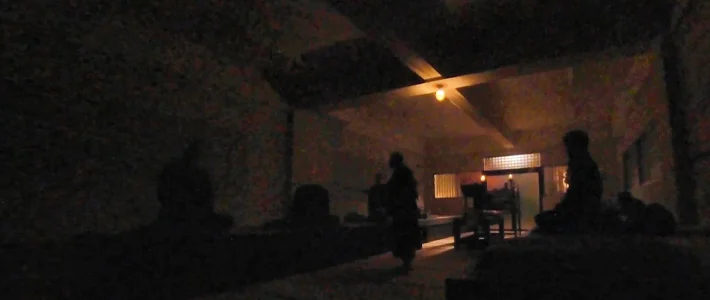
In 1968, the third-generation head priest, Kanko Osho (寛光), first built a zazen hall. In 1976, the main hall and priest's quarters were rebuilt. The temple community gradually recovered.
In the autumn of 2002, Yuko Osho became the temple's fourth-generation head priest.
Why This History Matters
Ikkeji's history is not separate from the history of Kure. The temple reflects the city's transformation into a naval town, its wartime destruction, its postwar hardship, and its rebuilding.
For a visitor, this makes Ikkeji more than a quiet place on a map. It is a small temple where local memory, Zen practice, and the everyday life of Kure continue to meet.